
Our Company | Window World of Boston | Woburn, MA
Get A Houseful Of Savings On Your Next Home Improvement Project!

    2026 How to Build a Single High-Performance API?

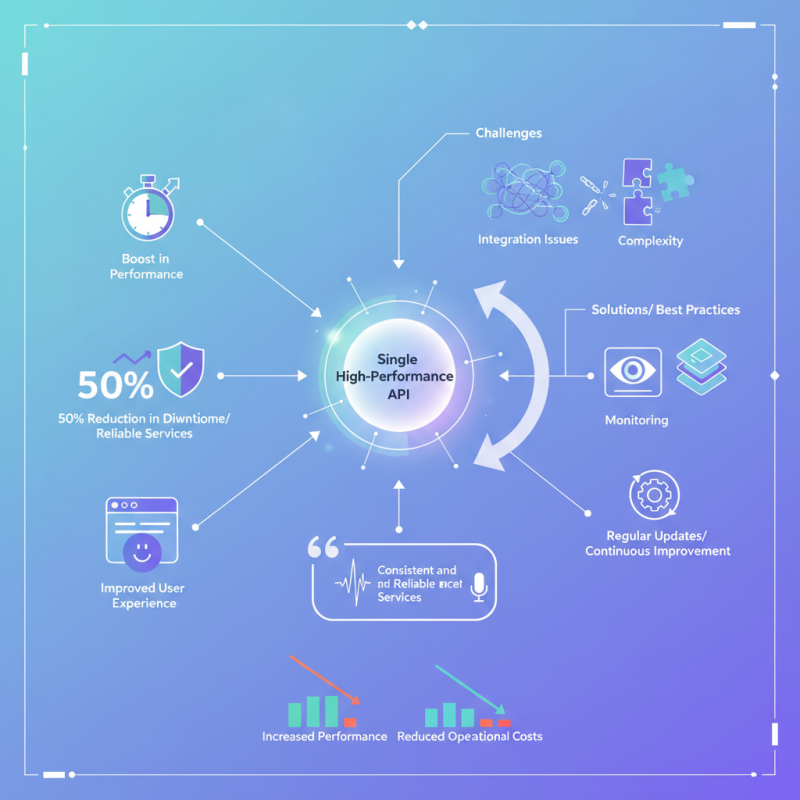
    In the rapidly evolving tech landscape, building a "Single High-Performance API" is crucial for organizations aiming to enhance their operational efficiency. According to a recent report from the API Management Institute, over 70% of companies see a significant boost in performance and scalability values when utilizing high-performance APIs. Experts suggest that these APIs can lead to a 50% reduction in downtime and an improved user experience.

    Renowned API architect John Doe emphasizes, "Creating a Single High-Performance API is not just about speed; it’s about delivering consistent and reliable services." This quote encapsulates the essence of what companies must strive for when developing their APIs. However, achieving this level of performance isn't without its challenges. Teams often struggle with integration issues and the complexity of maintaining optimal performance across different environments.

    While many organizations are eager to adopt these principles, they sometimes overlook crucial aspects like monitoring and regular updates. This oversight can lead to slower response times and increased operational costs. Companies must recognize the need for continuous improvement and adapt to changing user demands to fully leverage the benefits of a Single High-Performance API.
    2026 How to Build a Single High-Performance API?

    Understanding the Basics of High-Performance APIs in 2026

    In 2026, developing high-performance APIs remains critical for digital businesses. The shift towards microservices architecture has made it essential to create responsive and efficient APIs. According to industry reports, APIs that boast high performance can handle up to 100 times more requests per second than average APIs. This efficiency directly translates into better user experiences.

    Building a high-performance API requires careful attention to various factors. Latency should be minimal, ideally under 100 milliseconds. Compression techniques can be employed to optimize data transfer. However, many developers overlook these strategies. A focus on real-time monitoring can help identify bottlenecks. API gateways can also affect performance. They introduce an additional layer but may offer valuable features. Finding this balance is a challenge.

    It's also essential to consider security alongside performance. Over-optimizing for speed could compromise data integrity. A report indicated that 40% of security breaches occur due to poorly designed APIs. As businesses prioritize performance, they must not neglect these vulnerabilities. Continuous reflection and adaptation are vital. What worked last year may not suffice today. Staying informed about trends will help improve API strategies.


    Performance Metrics of High-Performance APIs in 2026

    This chart demonstrates the key performance metrics of high-performance APIs in 2026. The metrics shown include latency, throughput, error rate, and uptime, highlighting the essential aspects of API performance.

    Key Metrics for Evaluating API Performance: Response Time and Throughput

    When evaluating API performance, two key metrics stand out: response time and throughput. Response time measures how quickly an API processes a request. Ideally, this should be under 200 milliseconds. However, many APIs struggle to meet this. Analyzing latency can reveal bottlenecks. Are you sending too much data with each request? Maybe there’s a need for optimization.

    Throughput, on the other hand, indicates how many requests an API can handle within a specific time frame. Higher throughput is desirable, but achieving this is often challenging. You might discover that increased complexity in the code can reduce throughput. Regularly testing different scenarios is crucial. Can your API maintain high performance under heavy load?

    Monitoring these metrics can seem overwhelming. Yet, understanding the trade-offs is essential. Sometimes improving response time can negatively impact throughput. It's a balancing act that requires thoughtful consideration. Don't hesitate to experiment and iterate. Each API has unique characteristics that impact performance. Embracing a mindset of continuous improvement is vital for building a high-performance API.

    Best Practices for API Design: Scalability and Maintainability Considerations

    When designing a high-performance API, scalability and maintainability are critical. A study from the API Management Forum reveals that 70% of organizations struggle with scaling their APIs effectively. To avoid similar pitfalls, a well-defined architecture is essential. Using RESTful principles allows for better resource organization. Each endpoint should represent a resource, supporting intuitive interactions.

    Tips: Keep your API endpoints intuitive. Name them logically. Avoid ambiguous naming conventions. This ensures ease of use and reduces confusion for developers.

    As your API grows, managing changes can be challenging. Introducing versioning early in the design process can make updates smoother. In fact, 65% of API failures result from inadequate versioning strategies. With proper version management, developers can integrate new features without disrupting existing services.

    Tips: Document changes clearly. Provide comprehensive changelogs. This helps users understand updates and encourages smoother transitions.

    In the quest for high-performance APIs, keep user feedback in focus. Solicit input early and often. Iterative improvements based on real user needs enhance both scalability and maintainability. Sometimes, what seems perfect in design overlooks practical usage scenarios. Maintaining a flexible approach to user needs can lead to a more robust API.

    Utilizing Modern Technologies: Microservices and Serverless Architecture

    In today’s tech landscape, building a high-performance API can benefit immensely from modern technologies like microservices and serverless architecture. Microservices break down applications into smaller, manageable pieces. Each service operates independently and scales as needed. This independence allows teams to innovate rapidly. However, managing numerous microservices can be challenging. Communication between them may introduce additional complexity, leading to potential performance bottlenecks.

    Serverless architecture complements microservices well. It abstracts the underlying infrastructure. Developers focus on writing code instead of managing servers. This can lead to faster deployment times. Yet, the reliance on third-party services raises concerns about vendor lock-in. Transitioning to a serverless model might require significant adjustments for some teams. It's vital to consider these factors early on. Balancing flexibility and control is crucial in this journey. Each choice has trade-offs that must be carefully evaluated.

    2026 How to Build a Single High-Performance API? - Utilizing Modern Technologies: Microservices and Serverless Architecture

    Technology Description Benefits Use Case
    Microservices Architectural style that structures an application as a collection of loosely coupled services. Improved scalability, faster deployment, and resilience. E-commerce platforms, banking systems.
    Serverless Architecture Execution model where the cloud provider dynamically manages the allocation of machine resources. Reduced operational costs, automatic scaling, focus on code. Real-time data processing, API backends.
    API Gateway Server that acts as an entry point for API requests and manages traffic between clients and microservices. Centralized control, request routing, and security. Mobile applications, third-party integrations.
    Containerization Lightweight, stand-alone, executable software packages that include everything needed to run a piece of software. Consistent environment, easy deployment, isolation. Microservices deployment, continuous integration.

    Monitoring and Optimizing API Performance with Real-Time Analytics

    In today's digital landscape, the performance of APIs is crucial. Real-time analytics plays a key role in monitoring and optimizing this performance. Developers can track response times and error rates continuously. Metrics gather insights that flag potential issues before they escalate. This proactive approach ensures smoother user experiences.

    The challenge, however, lies in interpreting vast amounts of data. Metrics can be overwhelming. A simple dashboard might not reveal underlying problems. Teams often struggle to distinguish between normal fluctuations and significant issues. Regularly analyzing patterns can unveil hidden bottlenecks. It also encourages reflection on current processes and their effectiveness.

    Additionally, real-time tools should integrate seamlessly into existing workflows. However, integration can often be a hurdle. APIs require consistent evaluation and updates. Teams might overlook the importance of this step in the rush to deploy new features. Embracing a culture of continuous monitoring fosters improvement. It allows for quick pivots based on data, refining API performance further.

    Services We Offer
    Window World of Boston has an A+ BBB Rating and offers industry-leading solutions for replacement windows, doors, siding and more. We follow through every job from start to completion while our friendly, knowledgeable staff is there to answer your questions and provide any level of customer support you need. Window World is committed to providing the highest customer satisfaction.
    Testimonials
    Best Company!
    Window world is the best company I have ever dealt with. Everything is explained in full and the people are courteous and informative. The installer did a beautiful job...
    Sharon R
    Pleasantly, Stress Free
    My entire experience with Window World was pleasantly, stress free. This was the fourth company I had come to my home to give me an estimate. When the sales rep., David...
    Susan Rocco
    Extremely Positive Experience
    We had nothing but an extremely positive experience with Window World. From the sales people to the installation crew, everyone was very nice, very helpful, and they we...
    Howard Kelman
    23 Windows Installed
    Excellent. I had 23 windows installed and wrapped trim in not even two days. The installation team was professional. I was extremely happy with the quality of the produ...
    Anne C
    Professional & Courteous
    My salesman from Windows world was great! He knew that I knew what I wanted and you didn't try and deter me from it. He listened and got through the whole sales process...
    Cheryl Vassil
    Very Fair Pricing
    Excellent experience. Very fair pricing, great quality windows, and everyone who I spoke to or who came here to do work was extremely friendly. I really can’t say eno...
    Lindsay B.
    Perfection
    Window world was great, from the consultant Ron Hajj to the installers Quentin and Barry I cannot say enough. Perfection, I would definitely recommend Window World to anyone
    Jeff Russell
    Warranty is Outstanding
    I went with Window World after getting a few other quotes but I was referred to them from a friend. The experience was great from the quote to the finished results. Mat...
    Tanya Backer
    I Would Recommend
    The installers arrived at my house on time, and after introducing themselves got right to work. They were very knowledgeable, professional and willing to answer any que...
    Ann Mccabe
    Difference in the Temperature
    Extremely friendly crew and customer service is easy to work with. I can already feel a difference in the temperature of our house.
    Nicole Cronin
    Caring About Customers
    The installers were most efficient, friendly, polite, thorough. They answered all of my questions and engaged in conversation while they kept working. They made sure ev...
    John Kurdzionak
    Accreditation
    Window World is backed by these leading industry experts.
    • BBB
    • Boston Red Sox
    • Saint Jude
    • Window Word Cares
    • Veterans Airlift Command
    • nrca
    OC Platinum Preferred Roofing Contractor